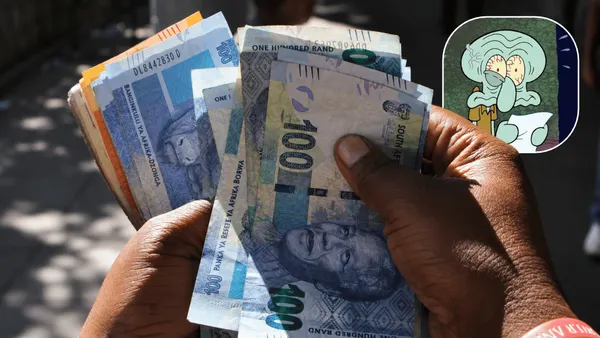
Ask most people what R17 to the dollar means for them, and you'll probably get a shrug. But the rand has been on quite the ride this year. In late January, it broke below R16 for the first time since 2022, boosted by record precious-metal prices and optimism about the economy, and after February's Budget, it touched R15.85. On Friday, though, it closed at R17.58, its weakest in more than a year. And there isn't just one reason. Like the film The Perfect Storm, where several weather systems collide at once, the rand is caught in a rare convergence of economic and political pressures.
The Iran war and the metals rally that held the rand up
To understand how we got here, we need to go back to 28 February. Before then, South Africa had growth of close to 2% in its sights, oil was around $65 a barrel and inflation had fallen to 3%. Then the US and Israel launched airstrikes on Iran, oil prices took off and local fuel prices climbed to record highs. In March, the rand slumped to R17.19, its worst level of the year until now.
Fortunately, a bull run in precious metals, some of South Africa's biggest exports, came to the rescue. It helped the country keep a healthy current account surplus over the first half of the year, and it helped the rand recover. By August, it was back below R16 again, touching R15.99 for the first time in almost six months.
The dollar, the bond sell-off and Gauteng's coalition talks
So what's changed? For starters, the dollar is flirting with a 19-month high, and markets have started pricing in a US interest rate hike in December. One Federal Reserve governor has even called for a bigger hike to bring inflation under control. That matters because higher US rates shrink the gap between what investors earn here and in America, making our bonds less attractive next to lower-risk US assets. Foreign investors noticed and sold a net R12 billion of our bonds in the first two weeks of November alone, more than R10 billion of it in the week to 13 November. Softer precious-metal prices have also knocked away one of the rand's biggest props.
Then there's the political storm. In the 4 November local elections, the DA won the most votes in all three Gauteng metros, including 35% in Johannesburg, well ahead of the ANC on 20% and ActionSA on 16%. Yet the ANC, ActionSA, the EFF and MK are closing in on deals that would shut it out. Johannesburg has had seven mayors since 2021 as coalition governments collapsed, and investors see these talks as a key test of whether fragmented politics can deliver stable governance in our economic hub. The Bureau for Economic Research warns that ousting the DA locally could spill over into the government of national unity.
Meanwhile, the Reserve Bank is facing a difficult decision of its own. It kept interest rates unchanged at 7.25% on Thursday, but three of its seven decision-makers wanted to raise them. Inflation is already above 5%, mainly because of fuel, and the Bank says it won't hesitate to raise rates if needed to bring inflation back to target.
So how does this reach you and me? A weaker rand makes everything we import pricier, and the Reserve Bank expects more pressure on food and other goods next year. Petrol is almost R30 a litre, up from R21 a year ago. Cheaper oil could bring petrol prices down by more than R3 in December, based on early projections, but the weaker rand has already clawed back 13 to 20 cents a litre of those savings.
Economists reckon it's a temporary setback until the coalitions settle and their stability is tested. But as with any storm, the question isn't whether it passes. It's how much damage it leaves behind.