
Today's edition
Arms Length
Good morning. Government is in a trusting mood today: it wants private money inside Denel's ammunition plant, it will pre-approve companies to hire foreigners if they score well enough, and it has signed for another R25 billion from the World Bank. Three different ways of admitting you cannot do it alone. Let's get into it.
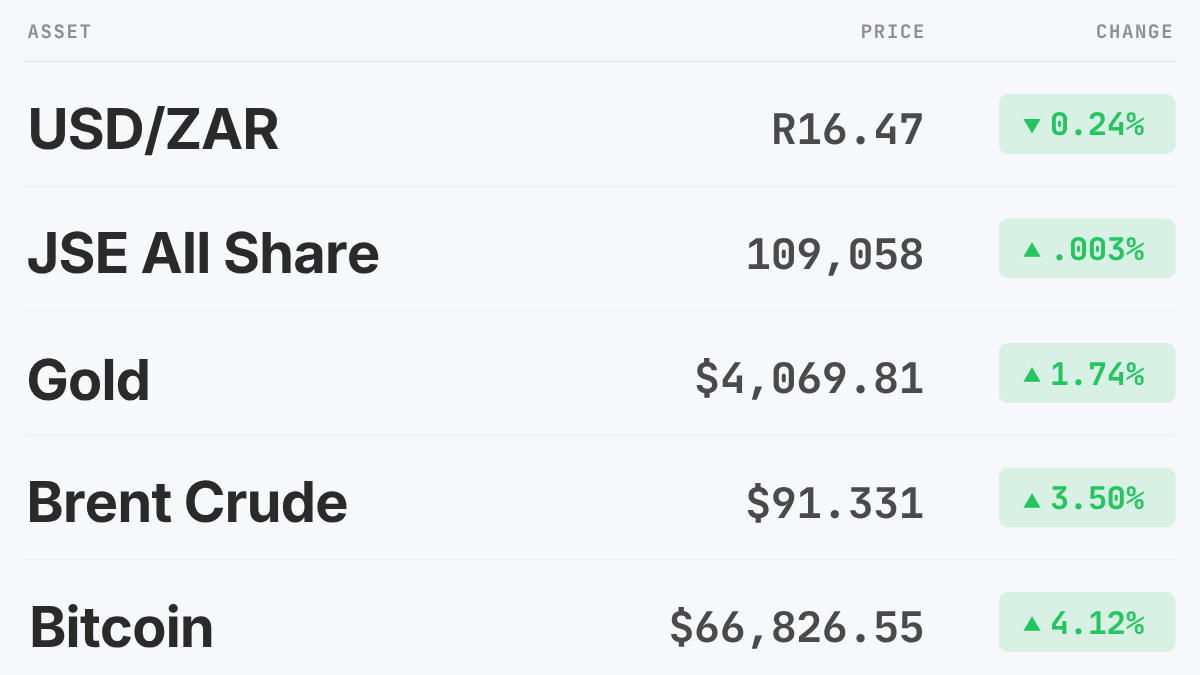
MARKETS
BRASS TACKS
South Africa's arms makers export to 115 countries, and their own government stopped buying
More than 600 South African companies build military kit, and over 80% of what they earn comes from selling it abroad, into more than 115 countries. Trade minister Parks Tau opened the Defence Industry Lekgotla in Pretoria on Monday with that number, and the argument it leads to: this is not a domestic industry that happens to export, it is an export industry that happens to be domestic. The state, meanwhile, has spent three decades buying less and less of what it makes. Denel, loss-making for about a decade, is now advertising for private investors to modernise its Pretoria ammunition plant.
What thirty years did to it:
- Defence force buying from local firms fell from R26.2 billion in 1989/90 to R850 million in 2017, in constant terms.
- Research funding dropped from R6.1 billion to around R500 million, and employment from about 130,000 people to roughly 13,000.
- Denel's brass foundry is the test case: private investors invited in, with bids closing on 10 August.
Africa's defence buying is forecast to reach about $136 billion, and Tau's warning is the simple one: countries that keep the capability capture that demand, and countries that do not just buy from someone else.
MAKING THE GRADE
Work visas just became a scorecard, and 80 out of 100 is the pass mark

Home Affairs has decided the problem with work visas is the checking, not the visa. Phase two of its Trusted Employer Scheme, gazetted on Monday, lets companies be vetted once and approved in advance, after which their skilled foreign hires move with fewer documents and less delay. The vetting is a scorecard, and there are three of them: one for local corporates, one for regional head offices, one for financial firms. Each needs 80 points out of 100. Expressions of interest close on 4 September.
BAGEL BITE
In what year was the first rubber eraser invented?
A. 1752
B. 1770
C. 1839
DOING THE ROUNDS
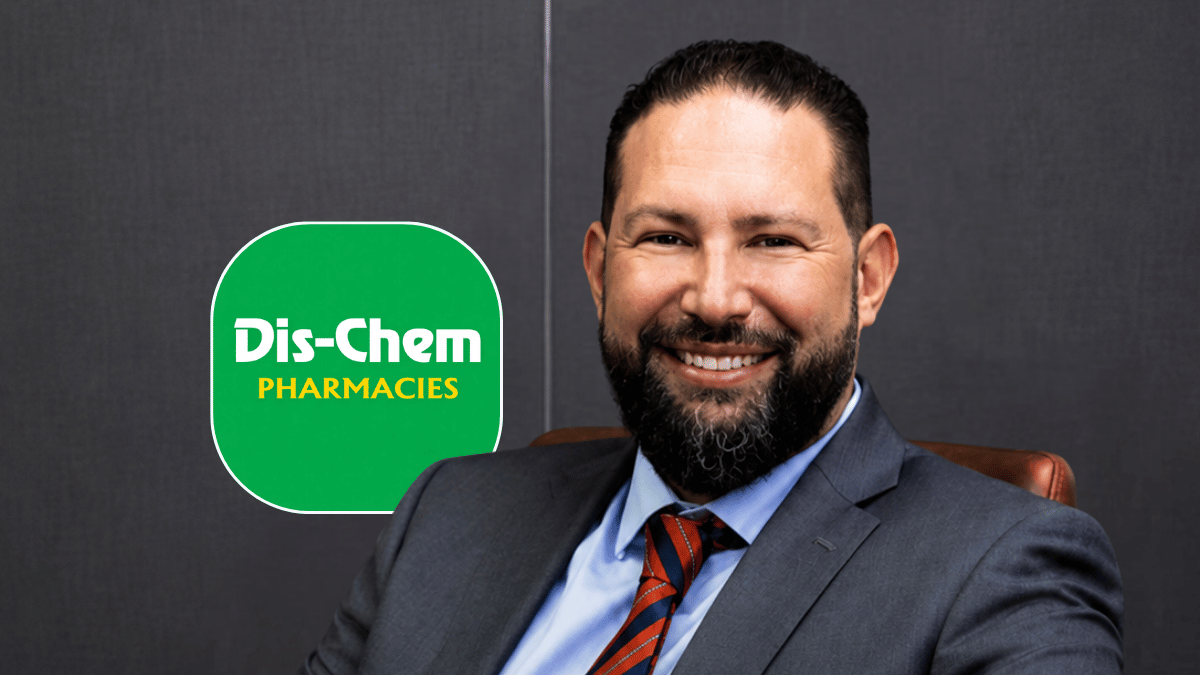
Dis-Chem has had a Saltzman in it since 1978, and as of Friday it has one fewer. Saul, son of founders Ivan and Lynette, resigned from the board after spending his entire 25-year career at the company, leaving his father as the last family member in the room. Ivan stepped back from running things at the end of June. Analysts called it unsurprising: the family handed the reins to chief executive Rui Morais in 2023 and has been selling down ever since. Full story →
Aspen has just been handed the right to sell a cheap copy of Ozempic in Canada, and no way to make it. Health Canada approved its generic version on Monday, in the same announcement where Aspen admitted it cannot say when the injection will reach shelves. The ingredient comes from India's Dr Reddy's, which hit an impurity problem and will be short until at least late October. Investors bought the approval and ignored the asterisk, pushing the shares 3.11% higher. Full story →
Samsung has spent seven years watching Apple hand out a credit card, and on Monday it reached for one of its own. The Galaxy Card, issued by Barclays on the Visa network, lands straight inside Samsung Wallet and pays 5% back on anything bought from Samsung, sliding to 1% on everything else. No annual fee, and $200 waiting for anyone who spends $2,000 in three months. Applications open across the US on Wednesday, the same day Samsung unveils its next Galaxy. Full story →
South Africa has borrowed R25 billion to fix the things that keep breaking. Treasury signed the World Bank loan on Tuesday, its fourth since 2022, and the first to put money behind water and sanitation rather than just electricity and freight. It runs 15 years, with three before repayments start, and costs less than the markets would charge. The World Bank reckons the reforms riding on it could support almost 600,000 more and better-paid jobs by 2032. Full story →
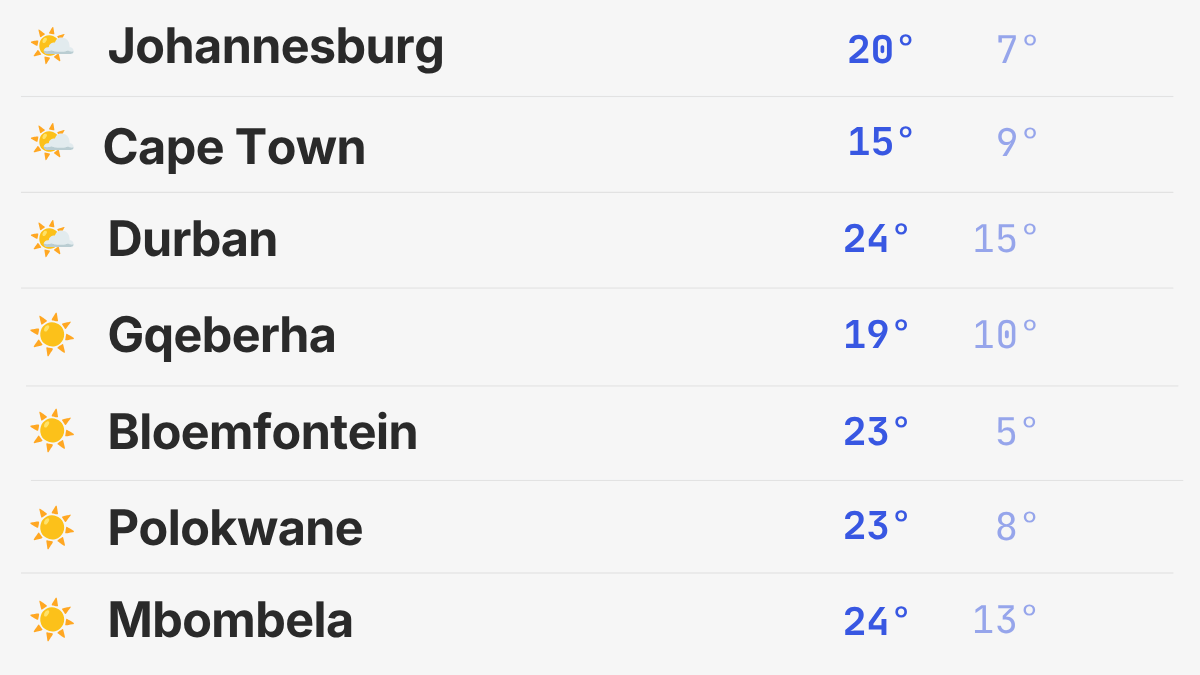
WEATHER
BAGEL GAMES

Have you got what it takes to win today’s Wordle? Play here →
THE ANSWER
As for the Bagel Bite, the answer is: B. 1770
In 1770, English engineer and instrument maker Edward Nairne became the first person credited with producing and selling rubber erasers. According to the popular account, he accidentally used a piece of natural rubber instead of the breadcrumbs commonly used to erase pencil marks and discovered that it worked remarkably well. Scientist Joseph Priestley also documented rubber’s erasing ability that same year. However, early natural rubber erasers deteriorated and became unpleasant over time. They only became more durable after Charles Goodyear developed the vulcanisation process in 1839.
That's your Wednesday sorted. Enjoyed it? Forward it on — a friend can subscribe in a click. Written by the Business Bagel crew.