
Today's edition
Service Not Included
Presented by
Good morning. A recent ruling against a local restaurant has raised some interesting questions about the economics of tipping in South Africa. And with Pepkor edging closer to launching its own bank, we're unpacking the bigger business play behind the move, plus the Reserve Bank's latest economic outlook and a property group's clever use of its empty offices. It's a big day for your wallet. Let's get into it.
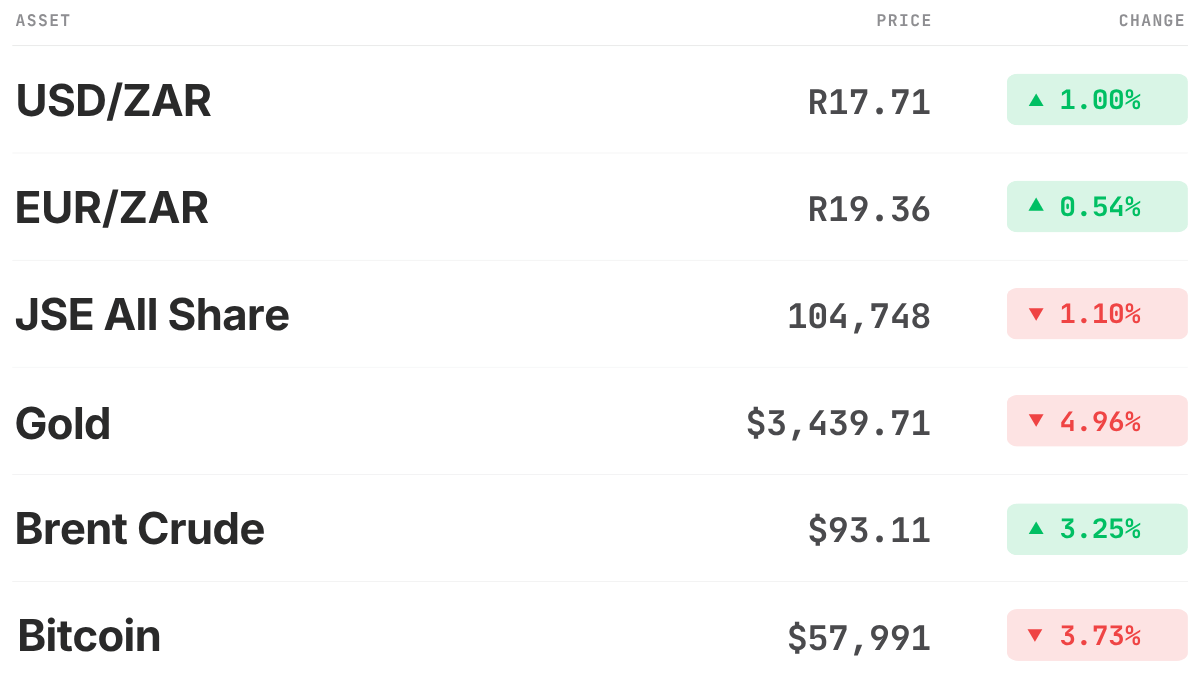
MARKETS
TIPPING POINT
That tip on your restaurant bill was supposed to be your choice, and now it legally is
Let's take a moment to talk about tipping. The number of places giving you the option to tip seems to have grown considerably, from restaurants and barbers to taxis, coffee shops and even some self-checkout systems. And what was once a fairly standard 10% increasingly feels like the starting point.
But being asked to tip is very different from finding one already on your bill. Last week, South Africa's National Consumer Tribunal ruled against TriBeCa Standard, a Pretoria restaurant that had been automatically adding a 10% gratuity to customers' bills, which they had to ask to have removed. A tip, it reinforced, should be something you choose to leave, not something you have to ask not to pay.
Big tables, bigger questions:
- Restaurants can still charge a fixed service fee for larger groups, says Werksmans director Armand Swart, as long as they explain what it covers and show the full price upfront.
- Supporters say many hospitality workers rely heavily on tips, and a standard gratuity gives them more certainty while keeping menu prices competitive.
- Critics say it shifts the job of paying a decent wage onto the customer, and some restaurants have scrapped tips for higher prices and better pay instead.
So which makes more sense to you: a fixed service charge on your bill, or slightly higher prices with tipping kept as a voluntary reward for good service?
BANKING ON PEP
Pepkor sells you clothes, phones and insurance, and now it wants to be your bank too
Pepkor, the company behind PEP and Ackermans, crossed R100 billion in annual revenue for the first time this week, with its shares closing more than 7% higher on Tuesday. But what really had shareholders buzzing was that its banking licence application is now in its final stages, and its own digital bank, currently called PlusB, could be up and running as early as April. Look at Pepkor's existing business and banking is a pretty obvious play: it has relationships with around 30 million customers, sells around 600,000 smartphones a month, and its financial services revenue grew 35% over the past year.
One of those financial services is personal loans, through Capfin. Today, Pepkor borrows money from financial institutions at one interest rate, lends it to customers at a higher rate, and makes money on the difference. With its own bank, it could use customer deposits to fund those loans instead, and because it expects to pay less interest on those deposits, that difference becomes bigger. Within five years of launching, Pepkor is targeting 1.8 million primary banking customers, with around R8 billion each in deposits and loans.
Shoprite is taking a different route, partnering with Investec on banking, but Pepkor says that hasn't changed its strategy. It hopes for final approval before year-end.
BAGEL BITE
Which country has the highest lowest point above sea level?
A. Nepal
B. Lesotho
C. Bhutan
DOING THE ROUNDS

Tongaat Hulett has told its sugarcane growers to stop deliveries and begun winding down its South African sugar operations. The company was relying on a R350 million loan from the state-owned IDC to keep operating while its sale to Vision Group goes through. But the IDC wants confirmation of repayment from Standard Bank, which is financing the acquisition and says it cannot provide that confirmation. Rescue efforts continue, but the livelihoods of around 2,500 employees and 15,500 sugarcane growers hang in the balance. Full story →
JSE-listed property group Octodec has found a rather clever way to fill its empty offices: launching its own beauty brand. It’s called I’Stayela Studios, and the idea is to convert vacant office space into smaller studios that independent hairdressers, barbers, nail technicians and other beauty professionals can run their businesses from. Its first location in Pretoria’s CBD already houses 60 of these units, and demand has been strong enough that Octodec plans to expand the concept. And with 25.5% of its office space sitting empty, there’s certainly room to do so. Full story →
The Reserve Bank has this tool called the leading business cycle indicator, which uses a range of economic data to give us an idea of where South Africa’s economy is heading over the next few months. And in September, it fell by 0.3%. Fewer residential building plans being approved and slower growth in the money supply were the biggest contributors to the decline, while higher prices for the commodities we export helped soften the blow. The indicator is still 1.8% higher than a year ago, but has now declined in 3 of the past 4 months. Full story →
And finally, less than a week after the biggest IPO in history, Anthropic is officially trading below its IPO price. Its shares opened at over $111 on the Nasdaq last Thursday, but have been falling steadily ever since, closing at roughly $81 on Tuesday. That means even investors who secured shares at the initial offering price of $83 are currently sitting at a loss, while those who bought shares when trading opened have seen their investment lose more than a quarter of its value. Full story →
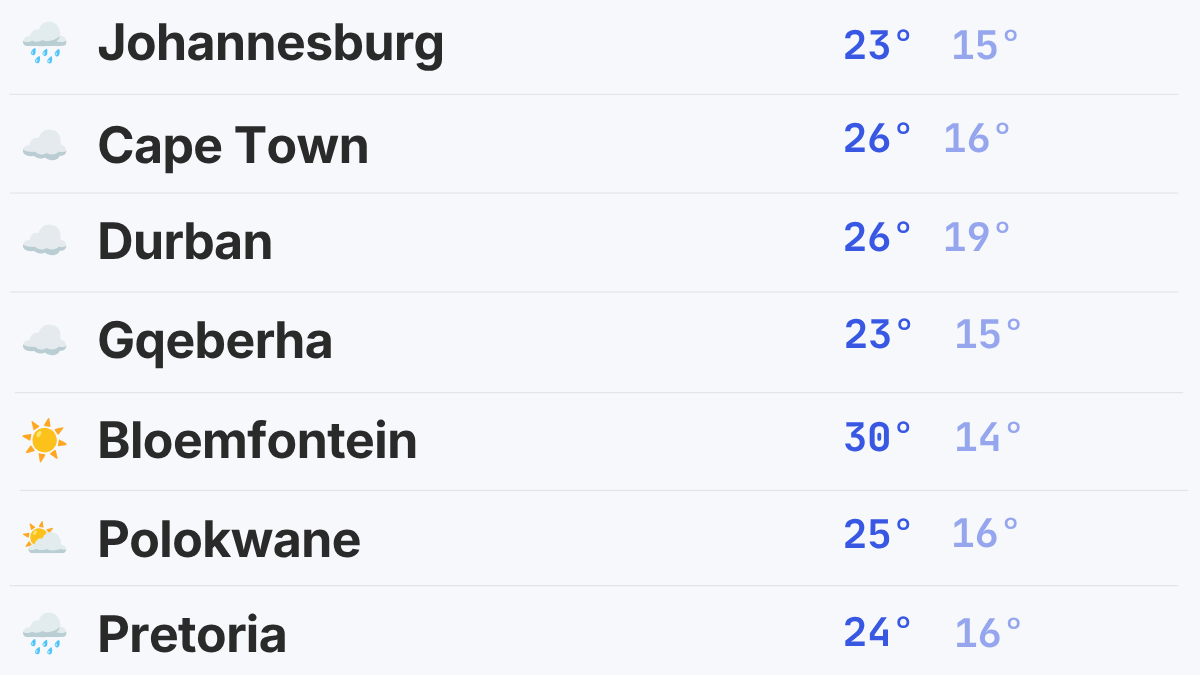
WEATHER
BAGEL GAMES
Have you got what it takes to win today’s Wordle? Play here →
THE ANSWER
As for the Bagel Bite, the answer is: B. Lesotho
Lesotho's lowest point, where the Orange and Makhaleng rivers meet, is still about 1,400 metres above sea level. That makes it the country with the highest lowest point on Earth, and the whole country sits above 1,000 metres. That's why it's nicknamed the Kingdom in the Sky. Nepal and Bhutan have the Himalayas, but their lowest points are less than 100 metres above sea level.
And that's a wrap on your Thursday. We'll see you tomorrow. Enjoyed it? Forward it on — a friend can subscribe in a click. Written by the Business Bagel crew.