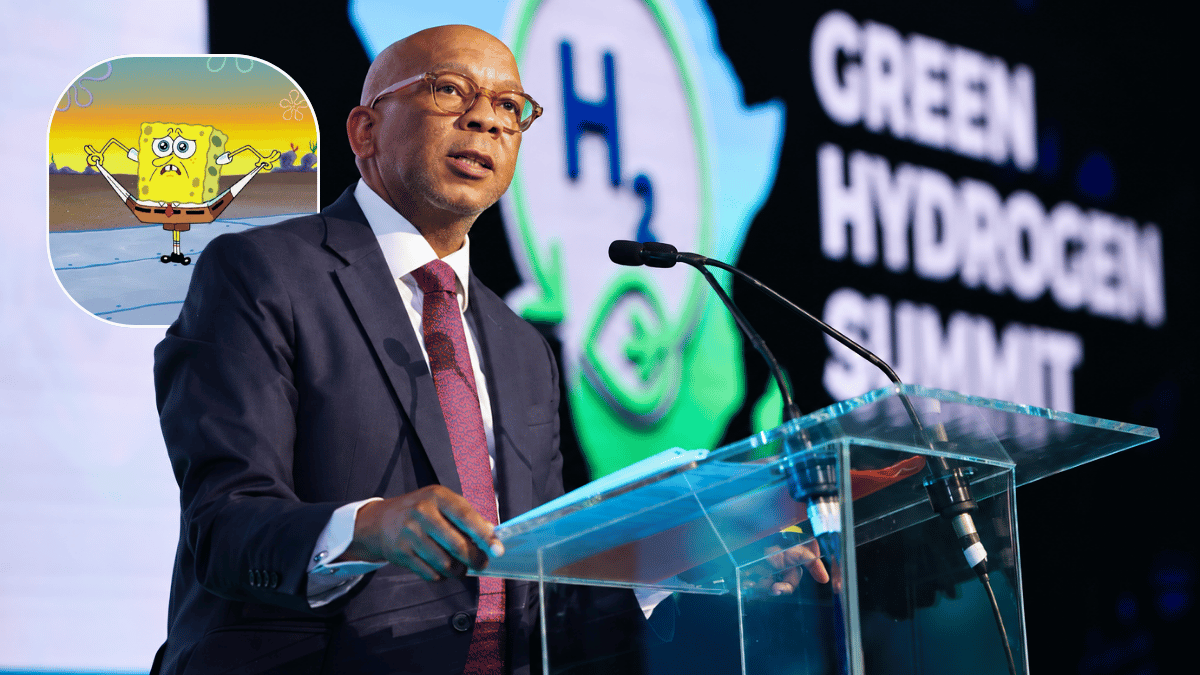
A pipeline of proposals is not an industry, and South Africa's green hydrogen plans have been a pipeline of proposals for years. On Tuesday the government named six projects it intends to put its weight behind, the first wave of a national programme, alongside a Green Hydrogen Deal Book meant to show investors and buyers what else is coming. Electricity and Energy Minister Kgosientsho Ramokgopa, delivering an address on behalf of President Cyril Ramaphosa, then spent a good part of it explaining what the announcement was not.
“Priority status is not the same as construction,” he told the summit in Cape Town. “A memorandum of understanding is not a bankable customer agreement. An expression of investment interest is not committed capital.” The credibility of the programme, he said, depends on government, developers and partners reporting each milestone for what it is.
The one that has the money
Only one of the six has reached the point where a board actually commits the cash, which the industry calls a final investment decision. Phelan Green Group's electro-sustainable aviation fuel project at Saldanha Bay has taken one: $100 million of equity committed, a buyer signed for the output, major equipment ordered and a defined route to construction. Building is expected to start in the first quarter of 2027, with the first fuel exported in the first quarter of 2029.
The buyer is the harder half. Quoting the World Economic Forum, Ramokgopa said the real bottleneck in scaling clean hydrogen is demand rather than technology, which is why the government's ask of the room was for prospective buyers to turn non-binding interest into long-term supply contracts a bank will lend against.
The five that do not
The other five sit at different distances from that point. The Coega green ammonia project in the Eastern Cape has finished early preparatory work and needs more commercial, technical and financing work before it can reach a decision. The Saldanha hydrogen direct reduced iron project, which would use green hydrogen to make lower-emissions iron and steel, is at pre-feasibility stage, as is the Green e-Fuels Producers green methanol corridor aimed at European demand. The Prieska Power Reserve in the Northern Cape, a green ammonia project for the domestic market, is at development stage. Green Hydrogen Solutions, the smallest of them and pointed mainly at South African demand, has completed its front-end engineering design.
Designation is the mechanism meant to move them. It concentrates project preparation, investment mobilisation and government coordination on projects with defined milestones, and it comes with a condition: where milestones are repeatedly missed without a credible recovery plan, Ramokgopa said, government and its partners must be prepared to send scarce preparation money somewhere with a better route to implementation. A second wave has already been assessed. None of the measures, he said, constitutes a gigawatt on its own.